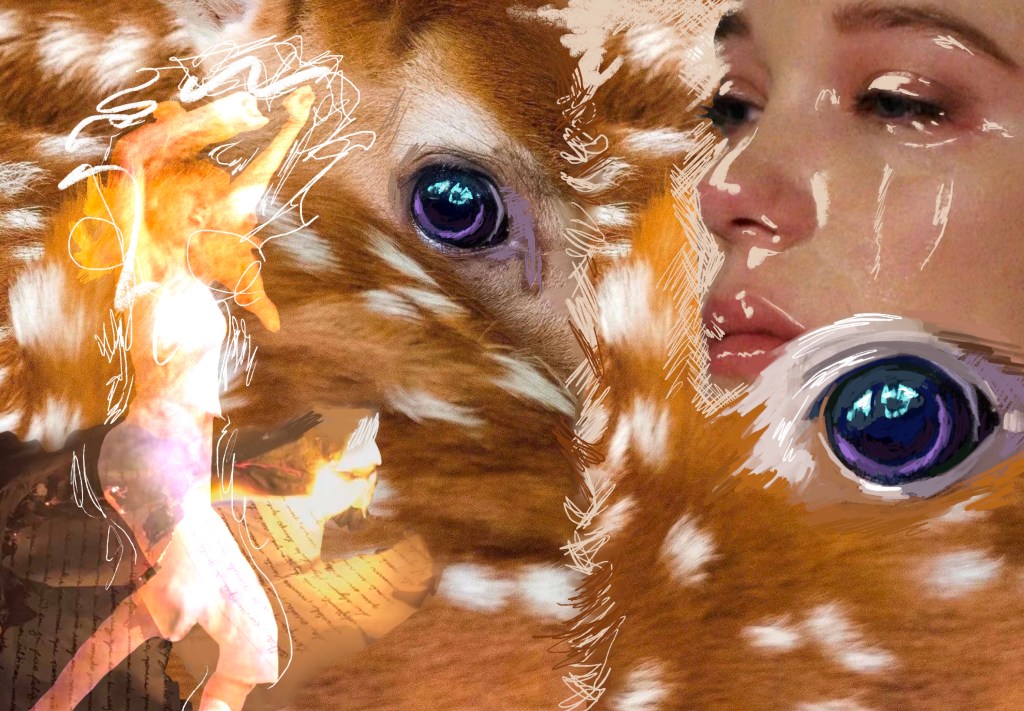
The day before my eighteenth birthday, with a heavy chest, I pressed the call button. “Hey, we really need to talk, but I don’t want to do this on my birthday”…… after a small tangent we both agreed to end things. Both unhappy for different reasons, but both beginning the roller coaster of emotions that come with a break up. He was my first kiss, my first limerence.

During the first few days loud music filled my room. “Feather” by Sabrina Carpenter was my favorite. Our bodies learn to flow with music it feels connected to, so did mine. That scene was, ofcourse, in tandem with my puffy eyes and a hurting heart. There was real physical pain, and what confusion it brought me. Firecrackers seemed to be going off in my chest chronically. I hoped to be gentle and understanding with myself. So, greeting my pain with curiosity only felt right.
A New Science?
On a trip with my best friend and her family, we celebrated both our birthdays. (Us scorpios really stick together). Shopping was a priority on our to-do list, her mom and I bonded over our shared love for it. My best friend not so much. However, we both wanted to visit a bookstore. We strolled the aisles for a while.
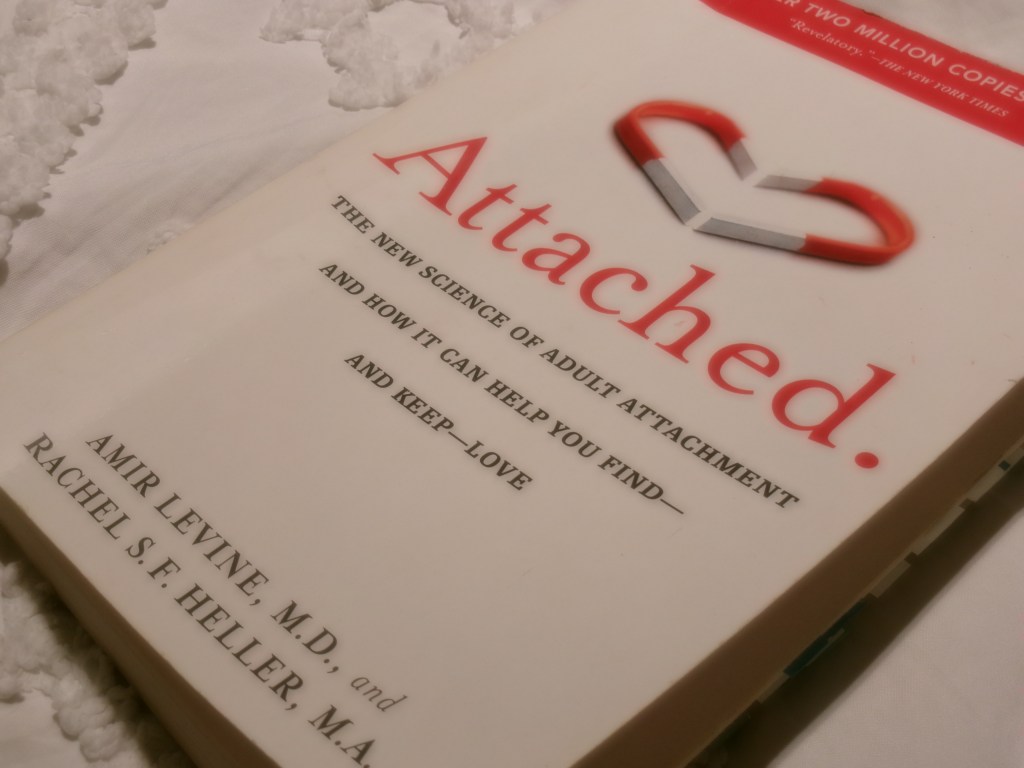
Looking for fantasy, romance, laughing at the smutty ones, and, then, stopping at the self-help section. Without really knowing what it was, I felt called to this book. (Clearly I wanted to find love again quickly, but this book would gift me something else.)
Anxious Attachment (The promise of not being alone)
There is nothing like feeling seen. that feeling of commonality is like a breath of fresh air. I never expected a book would give me that. It read me from head to toe, checking off the boxes of my behavior, it knew me. My self-diagnosis was an anxious attachment style, I have been sentenced to a life in an unregulated nervous system, tied to the whims of someone else. Here’s how the book explained this jail sentence:
- You love to be very close to your romantic partners (Yes)
- You have the capacity for great intimacy (yeah i think so)
- There’s a fear that your partner does want to be as close to you (Yes.)
- You’re attune to the minute fluctuations in your partner’s mood or actions (Very much)
- You take those fluctuations very personally (Oh my god yes)
- Only when the other person gives you reassurance can you shed the preoccupations. And if they don’t, well, mental hell breaks loose. (Check)
Attachment theory is based on the belief that humans have a biological gene that ties us to close relationships. John Bowlby made this realization around the 1960s and he explains how we are bred to depend on a significant other. It is inevitable, from the day you were born till the day you die, this gene plays an abundant role in your behavior. A great part of this theory stems from evolution, depending on the environments our ancestors lived in it would be either safer to have someone to depend on or the opposite, independence was key to survival. This is where the other attachment styles come into play.
- Secure: You are comfortable with intimacy and a loving relationship almost comes naturally. You can handle relationship matters without taking them personally and can communicate your needs directly.
- Avoidant: Independence is a priority above all else. You are often uncomfortable with too much closeness and felt the need to be on high alert, always “protecting your territory’”
(These are very concise explanations btw)
The fascinating thing about Attachment styles is that they are fluid, I was not actually sentenced to anything. Another key part for the origins of a person’s attachment style is their upbringing. Basically, how your parents cared for you as a baby dictated how your behavior towards closeness would develop. One of the first scientific literature about this was a research paper by Cindy Hazan and Phillip Saver. (Romantic love conceptualized as an attachment process., 1987). One of the findings was the frequencies in different attachment styles in infancy vs. adulthood. The frequencies showed similar percentages in both stages, and this would be the beginnings of the search for connections between attachment in childhood and attachment in adulthood.
“Dependency Paradox”
“ It turns out that the ability to step into the world on our own often stems from the knowledge that there is someone beside us whom we can count on—this is the dependency paradox.” (Attached. 2010)
I enjoy how the book talks about dependency. It is a biological truth that we become attached to a special someone. (The book references multiple studies that indicate this) A physiological unit comes from intimacy, two people come together to regulate each other’s psychological well being. In a culture that often appraises independence and differentiation, someone (like me) who was made to live with love in their everyday life cannot express this desire without feeling some sense of embarrassment. The fact is no one can run from the influence a partner has over the stress response. Too many factors come into play: physical proximity, availability, dependability, supportiveness, etc. This said, Happiness and independence is found the second you share your life with someone you can truly depend upon.
Understanding leads to kindness.
This book is not without its flaws, however it warmly wrapped my heart with understanding. My mind began to understand the rest of my body’s fluctuations. It was dealing with the uncontrollable forces that come into play when (you think) you chose someone special. So, to any heart out there that has been recently broken, don’t feel ashamed of your emotions. There is a beautiful biological part of you made to love, care, and to keep the person you love near. Your body thinks it’s keeping you safe, but it is oneselfs responsibility to be kind as one painfully heals.
 Birdie Writes